Species Keepers

Growing local native plants. Learning how ecosystems work. Caring for Country.
Species Keepers is a hands-on learning program that supports schools and families to grow local native plants from seed while building understanding of ecosystems, pollinators, and biodiversity.
Students take part in real-world conservation actions — observing seed germination, nurturing seedlings, and exploring how plants, insects, animals, and people are connected. Through these experiences, abstract ideas about sustainability and living systems become tangible, observable, and meaningful.
The program is grounded in local species and place-based learning, with a strong focus on learning by doing. Students not only grow plants, but also learn where seeds come from, how they are collected, processed, and stored, and why these steps matter for the health of local landscapes.
Species Keepers contributes to the Snowy Monaro Native Seed Strategy, a regional effort to address the significant shortage of locally sourced native seed available for revegetation and restoration projects. By involving schools and families in seed stewardship — from collection through to growing plants — the program helps build practical knowledge while supporting long-term ecological resilience.
Planting local native species on school campuses and at home provides habitat for insects, birds, and other wildlife, and strengthens connections between cultivated spaces and surrounding bushland. Over time, these plantings contribute to healthier, more resilient local ecosystems and support the recovery of degraded areas across the region.
Species Keepers is delivered by Wagtail Natives Nursery, a Snowy Monaro–based native plant nursery specialising in locally sourced, hardy native plants for restoration, education, and habitat.
Who is Species Keepers for?
Species Keepers is designed for:
-
Preschools, primary and secondary schools
-
Teachers and educators looking for practical, curriculum-linked learning
-
Homeschooling families interested in nature-based education
The program is flexible and can be adapted to suit different year levels, school contexts, and learning environments.
Why it matters
Healthy ecosystems depend on diverse, locally adapted plants.
Through Species Keepers, students learn that:
-
Seeds are the starting point for healthy landscapes
-
Plants provide habitat and food for insects, birds, and animals
-
Biodiversity makes ecosystems more resilient to change
By growing plants from seed and observing their role in local habitats, students develop a deeper understanding of how caring for plants helps support wildlife and strengthen ecosystems — now and into the future.
What participation looks like
Schools and families participating in Species Keepers:
-
Grow selected local native plants from seed
-
Observe and record germination and growth over time
-
Explore plant–animal relationships, including pollinators and insects
-
Take part in simple investigations and seasonal activities
-
Reflect on learning through observation, discussion, and documentation
Participation can be scaled up or down depending on time, space, and interest.
Species Keepers is tailored to suit different school contexts, year levels, and timetables.
Programs can be delivered as:
- Remotely supported classroom activities with growing kits and guidance
- A single presentation or interactive workshop
- A short workshop sequence delivered across a term
- An extended program delivered across a school year, with seasonal learning
Support, materials, and activities are adapted to meet the needs of each school, allowing educators to create a structured yet flexible learning program for their students.
Case Study 1
Three workshops — campus planting, seed sowing, and seedling care
Context
Primary students participated in a sequence of Species Keepers workshops delivered on their school campus. The program focused on growing local native plants from seed while building understanding of pollinators, plant growth, and healthy ecosystems. Learning was designed to build progressively across multiple sessions.
Workshop sequence
Workshop 1 (1 hour) — Campus planting and pollinators
- Planting local native species around the school grounds
- Interactive presentation on pollinators and flower traits (colour, size, shape)
- Introduction to edible native plants
- Learning about conditions required for healthy plant growth
- Exploring environmental benefits of planting native species
Workshop 2 (1 hour) — Seed sowing and germination
- Sowing seed of local native plant species
- Learning about the seed life cycle and soil nutrients
- Investigating conditions required for germination
- Making predictions about germination success
- Recording observations and testing different growing conditions
Workshop 3 (1 hour) — Seedling care and potting on
- Potting on seedlings into individual tubes to grow on
- Learning to recognise plant health and growth stages
- Revising best-practice planting techniques for seedlings
- Comparing growth and reflecting on factors influencing success
- Documenting key learning points as advice for future participants
Learning outcomes
Students developed understanding of plant biology, seed life cycles, pollination, and plant–environment relationships. They built investigation skills including observation, prediction, recording data, and reflecting on change over time. Learning was consolidated through documenting advice for future Species Keepers students.
Case Study 2
Research, field observation, and planting to support local pollinators
Context
Primary students participated in a Species Keepers learning sequence focused on understanding local pollinators and their relationships with native plant species. The program combined classroom-based research, a supervised field excursion, and a campus-based workshop.
Learning sequence
Classroom learning (multiple lessons) — Research and investigation
- Researching local native plant species and pollinators
- Exploring pollinator preferences and flower characteristics
- Investigating where selected plant species occur in local bushland
- Identifying a suitable local site for field observation
Field excursion (1–2 hours) — Pollinator survey
- Conducting a supervised pollinator count at a local bushland site
- Observing pollinators interacting with plants
- Using the citizen science platform iNaturalist to identify and record sightings
- Collecting data on pollinator diversity and activity
Campus workshop (1 hour) — Growing for habitat and seed
- Analysing pollinator survey results and observations
- Selecting two local plant species to support identified pollinators
- Sowing seed and planting selected species on the school campus
- Learning about seed life cycles and growing conditions
- Discussing the role of school plantings in supporting habitat and future seed production
Learning outcomes
Students developed understanding of pollinator–plant relationships, field survey methods, and evidence-based decision-making. They built skills in research, species identification, data collection, and applying scientific observations to real-world conservation actions.
Learning connections
Species Keepers is grounded in science learning, with a focus on understanding living systems through observation, investigation, and care. Students explore how plants grow, how ecosystems function, and how interactions between species shape the natural world.
Through the program, learning is supported across:
-
Science — living things and their needs, life cycles, ecosystems, and scientific inquiry skills such as observing, recording, comparing, and drawing conclusions.
-
Sustainability and environmental education — exploring how human actions influence ecosystems, and how caring for plants and habitats supports long-term environmental health.
-
Place-based learning — using local native species and nearby habitats to connect learning to place, context, and lived experience.
The hands-on nature of Species Keepers also creates natural links to other learning areas. Activities can be extended or adapted to support:
-
Literacy — journalling observations, explaining processes, writing reflections, and communicating findings.
-
Numeracy — counting and comparing germination rates, measuring growth, recording change over time, and working with simple data sets.
-
Creative and critical thinking — designing investigations, problem-solving, noticing patterns, and making connections between cause and effect.
-
The Arts and design — drawing plants and insects, documenting change visually, designing garden spaces, or creating interpretive materials.
-
Personal and social capability — collaboration, shared responsibility, patience, and care for living things.
Curriculum links are provided at a high level, allowing teachers and educators to adapt activities to suit their year level, learning goals, and classroom context.
Practical information
Species Keepers is designed to be well supported and flexible, so educators can confidently adapt the program to their students and setting.
Growing kit and materials
Participating schools and families receive a growing kit tailored to the age and learning context of their students. Kits include seed from locally appropriate native species, along with materials and resources to support sowing, care, and monitoring. Detailed guidance is provided so students can follow plant growth over time and understand what their observations mean.
Online learning platform
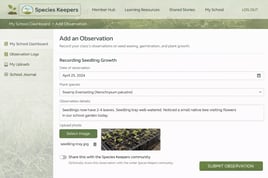
Participating educators are provided with access to a private online platform that supports participation in the program. The platform enables schools and families to record seed sowing, germination, and plant growth, upload photos and observations, and access shared learning resources. Each school or family has their own private space, with sharing always optional and teacher-controlled.
Time commitment
The program is flexible and can be implemented as a short learning sequence or extended across a term or year. Activities can be revisited seasonally, allowing learning to build over time.
Space required
Species Keepers can be delivered in a range of settings, including garden beds, outdoor learning spaces, balconies, or small areas using pots or trays. The program is designed to work within the practical constraints of school and home environments.
Support and guidance
Educators are supported with clear instructions, activity ideas, and access to shared learning resources through both the growing kit and the online platform. Guidance is structured but not prescriptive, allowing teachers to align activities with curriculum goals and student interests.
Flexibility in delivery
Species Keepers is not a fixed unit of work. Educators are encouraged to adapt activities, extend investigations, and integrate the program across learning areas in ways that suit their students and timetable.
Online learning space
Participating schools and families will be supported by a private online space where they can:
-
Record seed germination and plant growth
-
Upload photos and observations
-
Access shared learning resources
-
Reflect on learning over time
Each school or family will have their own private space. Sharing with the wider Species Keepers community will always be optional.